

Specialized Analysis of Low-Temperature Brittleness Resistance and Low-Temperature Pull-Out Force Stability of Artificial Grass Fibers
Aug 12, 2026
While standard parameters in the artificial turf industry-such as dtex, density, backing fabric, drainage, and UV resistance-have become highly standardized and commoditized, critical "hidden" performance metrics-specifically low-temperature crack resistance and tuft bind stability-are rarely discussed, despite directly determining the service life of outdoor fields in northern regions. Most testing standards rely on ambient temperature benchmarks, failing to account for the freeze-thaw cycles and extreme cold (-10°C to -30°C) found in high-latitude areas; this mismatch is a primary reason for the premature aging and high rework rates of turf in the north. This article provides a concise analysis of failure modes, technical distinctions, industry inconsistencies, and key selection criteria regarding this performance aspect.

I. Key Field Manifestations of Low-Temperature Performance Failure
Standard artificial turf utilizes generic formulations for its fibers and backing adhesives. In cold environments, the polymer materials undergo a glass transition, resulting in a significant loss of toughness and triggering two types of irreversible field issues. First is fiber embrittlement and breakage: foot traffic or snow removal friction in winter causes mass fiber breakage, leading to irreparable "bald spots" where the backing is exposed come spring. Second is delamination and blistering: low temperatures cause the backing adhesive to harden and lose elasticity; combined with diurnal freeze-thaw cycles, the adhesive layer cracks and delaminates, causing fiber tufts to detach and rendering the field unusable. Furthermore, material damage caused by low temperatures does not self-heal when temperatures rise; instead, it accelerates the overall aging process of the turf.
II. Core Technical Differences Between Standard and Cold-Resistant Turf
The disparity in low-temperature performance stems primarily from differences in raw material formulations and backing application processes, rather than visual appearance or thickness. Standard turf employs generic polyethylene and conventional SBR backing, resulting in poor low-temperature toughness and a high susceptibility to cracking; in cold conditions, tuft bind strength (fiber pull-out resistance) can plummet by 40%–60%. In contrast, specialized cold-resistant turf utilizes metallocene-modified raw materials combined with low-temperature toughening additives and optimized vulcanization ratios for the backing adhesive. This significantly lowers the material's glass transition temperature, allowing it to maintain excellent toughness at -25°C-where fibers bend without cracking or stress whitening-and limiting the reduction in tuft bind strength to under 20%, thereby offering performance stability far superior to that of standard turf.

III. Common Industry Issues and Key Points for Avoiding Pitfalls in Product Selection
Issues regarding low-temperature performance in the industry are both prevalent and often overlooked: neither standard national tests nor FIFA certification protocols mandate low-temperature testing, meaning most compliance reports reflect only room-temperature data. Suppliers often pass off standard turf as specialized turf designed for alpine climates, exploiting the lack of visual distinction to undercut prices while relying on unsubstantiated verbal claims regarding cold resistance rather than specific test data. When selecting and accepting products, specific precautions are essential: for projects in cold northern regions, one must demand specialized test reports covering low-temperature brittleness/cracking resistance, low-temperature pull-out resistance, and freeze-thaw cycle durability. The substitution of standard turf for cold-resistant turf in winter installations is strictly prohibited. Furthermore, while standard turf must not be cleared using hard scraping tools in winter, cold-resistant turf is compatible with light mechanical snow removal.
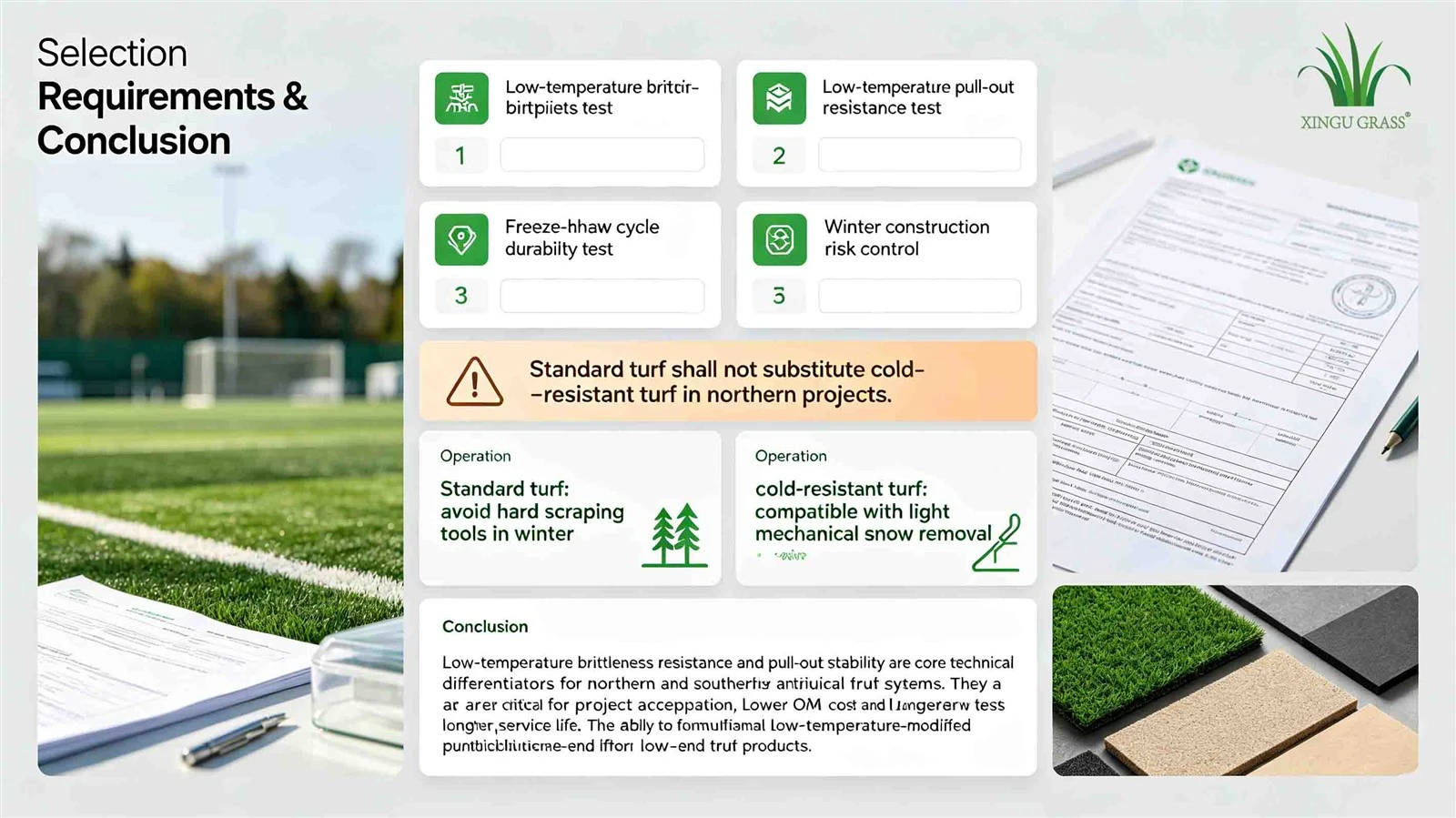
In summary, resistance to low-temperature brittleness and the stability of pull-out resistance represent the core technical differentiators between artificial turf products designed for northern versus southern climates; they are also critical metrics for project acceptance, the reduction of O&M costs, and the extension of the facility's service life. In a market where standard specifications have become homogenized, a manufacturer's capability to formulate low-temperature-modified compounds serves as a key criterion for distinguishing between high-end and low-end artificial turf products.


