

6 Hidden Artificial Grass Buying Mistakes That Cost Importers Thousands
Aug 18, 2026
Avoid common artificial grass sourcing mistakes that cause fading, returns, and profit loss. Practical buying guide for turf importers, distributors and project contractors.
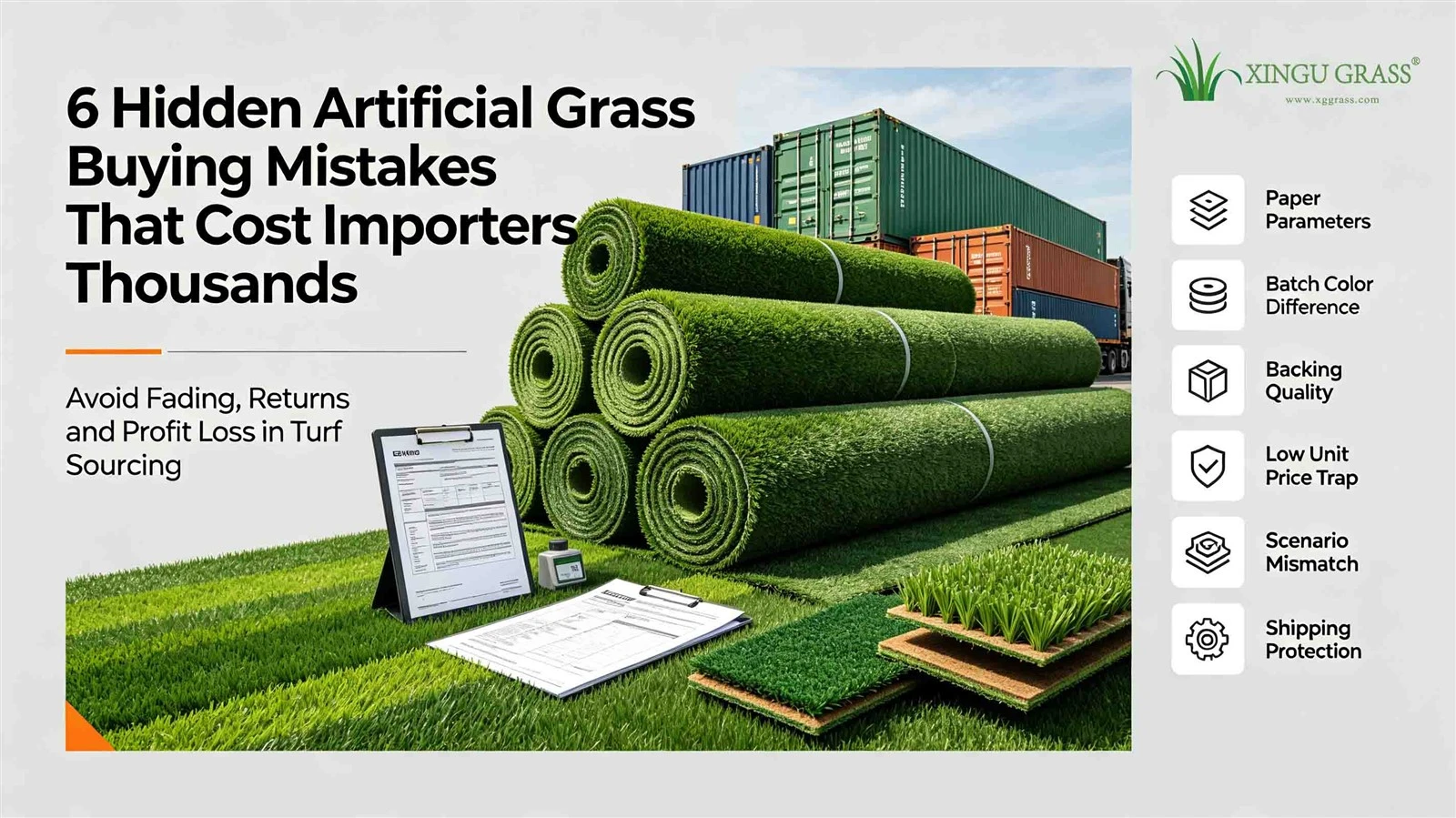
Most artificial grass importers and distributors lose money not because of high product prices, but because of invisible buying traps. Many suppliers quote similar parameters on paper, yet deliver inconsistent quality after shipment. While technical indicators like Dtex, stitch density, and UV resistance are well-known, few buyers notice the hidden factory tricks that lead to large-scale returns, customer complaints, and wasted project budgets. To stabilize profit and long-term market reputation, professional turf buyers must avoid these easily overlooked sourcing mistakes.
The first common mistake is trusting paper parameters without verifying real production standards. Many small factories modify test data for quotations. They label products as 10000 Dtex or 3000-hour UV resistance, but use thinner yarn and surface-only UV coating in mass production. The difference cannot be distinguished from samples. After installation, the turf fades quickly or sheds fibers within months. Buyers must confirm third-party SGS reports and request pre-shipment inspection instead of only checking quotation sheets.
The second mistake is ignoring batch color difference. Artificial grass color is affected by raw material batches, temperature control and masterbatch proportion. Factories with unstable production lines often produce uneven color between different batches. For large landscape and sports projects, batch color difference will cause patchy lawn appearance, directly leading to project rejection. Reliable suppliers strictly control unified color calibration for every order to ensure consistent visual effect.
Third, many buyers overlook backing and glue quality to save costs. Low-grade turf uses recycled backing and inferior SBR glue. After rainwater soaking and high-temperature exposure, the backing shrinks, delaminates, or peels off. Poor glue also causes fiber dropping. Even if the yarn looks thick and dense, unstable backing shortens the service life drastically. For coastal, rainy and high-temperature markets, qualified PU backing and high-strength glue coating are essential.
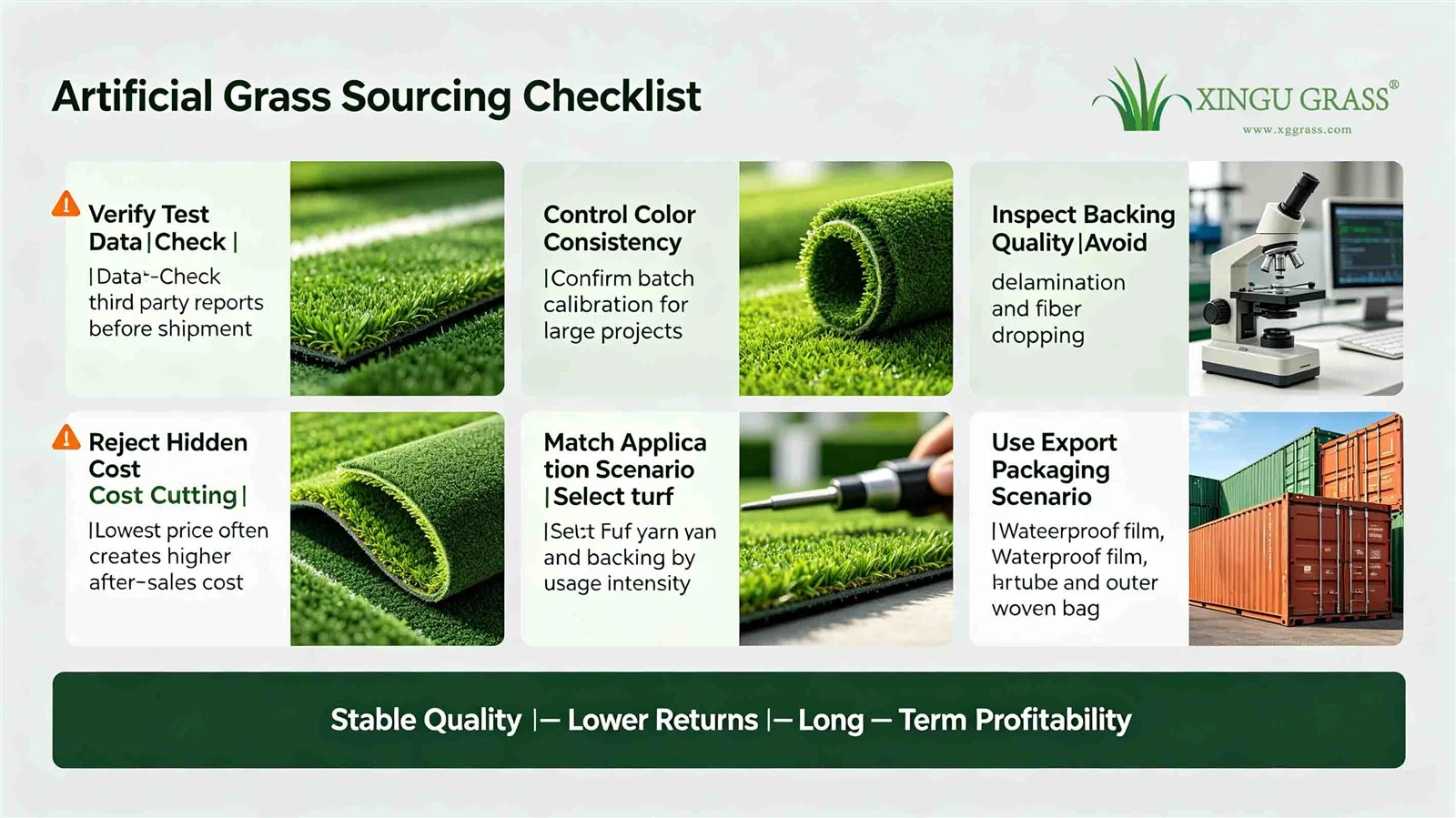
Fourth, blindly pursuing low unit price kills profit space. Ultra-low-price turf always cuts corners on invisible parts: reduced yarn weight, lowered UV formula, thinner backing, and simplified drainage holes. Although the initial procurement cost is low, the after-sales cost, replacement cost and customer loss far exceed the saved money. Mature distributors choose cost-effective stable-quality products rather than the cheapest ones.
Fifth, ignoring scenario matching causes mismatched products. Many buyers order general landscape grass for heavy-traffic playgrounds or sports fields. Ordinary turf cannot resist frequent friction and pressure, resulting in rapid aging and damage. Different scenarios require targeted yarn toughness, density and backing strength. Correct scenario matching greatly reduces after-sales risks.
Sixth, neglecting packaging and shipping protection. Improper rolling and simple packaging cause turf creases, edge deformation and dirt contamination during long-distance sea transportation. These problems affect installation flatness and customer satisfaction. Standard export packaging with waterproof film, hard paper tube and outer woven bag ensures intact product condition after long ocean shipping.
In short, artificial grass sourcing is not a simple parameter comparison game. Real professional purchasing lies in identifying hidden quality differences and avoiding industry traps. By verifying real test data, controlling batch consistency, focusing on backing quality, matching correct scenarios, and insisting on standard export packaging, importers can effectively eliminate after-sales risks, stabilize end customers, and maintain long-term profitable development in the competitive global turf market.