

Non-Infill Artificial Turf: A Lightweight Solution Renovating The Sports Venue Industry
Jun 17, 2026
For a long time, traditional infill artificial turf has relied on quartz sand and rubber granules to support grass fibers and provide sports cushioning for sports venues. However, inherent drawbacks including dust pollution, continuous later-stage maintenance and long construction cycles have greatly restricted the development of the industry. As a core technological innovation in the artificial turf industry in recent years, non-infill artificial turf completely abandons auxiliary filling materials. It adopts high-density grass fiber structure, straight and curved mixed weaving technology and composite buffered backing to form a self-supporting system. With three core advantages of safety and environmental protection, low operation and maintenance costs, and rapid installation, it has become the preferred choice for campuses, community youth training venues and leisure sports courts, reshaping the demand logic of the downstream artificial turf market.
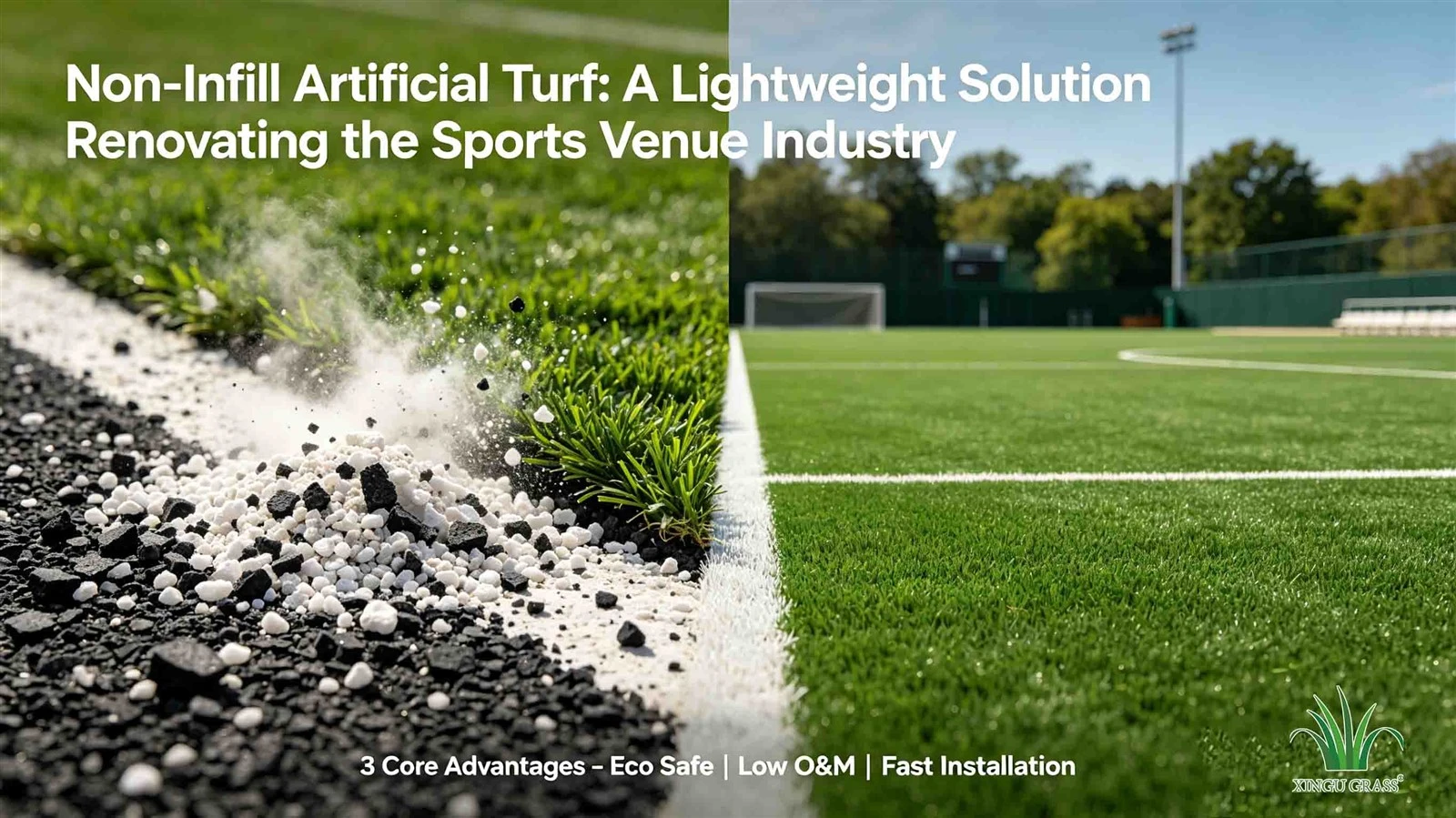
There are essential differences in core craftsmanship between non-infill turf and traditional infill turf. Traditional infill turf features a grass fiber height of 40–60mm and a tuft density of only 8,000–12,000 tufts per square meter. The gaps between grass fibers are fixed upright by quartz sand and cushioned by rubber granules. In contrast, non-infill turf adopts a short grass fiber design of 20–35mm with the tuft density increased to 16,000–21,000 tufts per square meter. It combines high-denier PE straight fibers and spiral curved fibers through mixed weaving, and the intertwined curved fibers form an internal supporting framework to replace the fixing function of quartz sand. The bottom is compounded with a 5–10mm TPE elastic cushion to replicate the shock absorption performance of rubber granules.
The entire functional system is integrated before delivery, requiring only on-site splicing and marking before put into use. This reduces the construction cycle by more than 40% compared with traditional infill turf, eliminating multiple processes such as procurement, transportation and paving of sand and rubber granules, and cutting the overall initial construction cost by about 25%.
Safety and environmental protection are the most competitive strengths of non-infill turf, making it perfectly suitable for sensitive scenarios such as kindergartens, primary and secondary schools, and youth sports training. The rubber granules of traditional turf will gradually pulverize under long-term trampling, producing microplastic dust that adheres to clothes and may be inhaled or accidentally ingested by children. Under high-temperature exposure, rubber granules release volatile harmful substances, and dust will cause soil and water microplastic pollution after being washed by rainwater.
In comparison, non-infill turf requires no auxiliary fillers throughout its service life. Its grass fiber raw materials are added with compliant UV-resistant and environmentally friendly modifiers, and most products pass the EU REACH standard and China's GB 36246 environmental standard for campus venues, with heavy metal and VOC content far below the limit values. The recycling rate of waste turf can reach 90% without secondary pollution. In addition, the smooth and particle-free surface greatly reduces sports slips and abrasions. Its rainwater drainage efficiency is improved by over 40%, allowing the venue to resume use within 30 minutes after rainfall. It avoids particle hardening and freezing problems in northern rainy and low-temperature areas, ensuring stable year-round use.
The advantages of full-life-cycle operation and maintenance costs further enhance the commercial value of non-infill turf. After the operation of traditional infill turf, regular professional maintenance such as grass combing, sand refilling and particle supplementing is required every year, with an average annual maintenance cost of about $1.2 per square meter. A large number of particles will be lost after 3–5 years, requiring overall renovation of the filling layer and bringing long-term operational burdens. Non-infill turf has no risk of filler loss. Daily maintenance only includes regular leaf cleaning and stain flushing without professional equipment or extensive labor, reducing annual maintenance costs by 50%–70% and greatly lowering the management pressure for schools and community parks without professional venue maintenance teams. With a service life of 6–8 years for standard products and over 8 years for high-end glass fiber backing upgraded versions, it delivers higher cost performance for small and medium-sized venues when considering the overall initial construction and later maintenance costs.

Nevertheless, non-infill turf is not a one-size-fits-all solution with clear application boundaries. Its fiber supporting force and shock absorption performance are slightly inferior to standard infill turf, so it is not suitable for high-intensity professional competitions and full-load daily professional training venues. Long-term high-frequency use may cause slight grass fiber lodging and faster ball rebound speed, resulting in weaker competitive control feel. The two types of turf are not substitutive but complementary in the market: infill turf is prioritized for professional competition venues, while non-infill turf dominates youth campus, community leisure, courtyard and small indoor sports venues, forming a differentiated market layout.
With tightening global environmental policies, expanding campus football infrastructure and booming overseas demand for small and medium-sized sports venues, non-infill artificial turf has become a core growth track of the industry. Manufacturers continue to optimize special-shaped cross-section grass fibers, glass fiber shrink-resistant backing and integrated buffer bottom layer technologies to narrow the performance gap with traditional infill turf. Globally, procurement demand for non-infill turf in Europe, America, Southeast Asia and South America keeps rising, as its lightweight design, convenient transportation and low environmental risks perfectly meet the needs of foreign trade exports. In the future, upgraded non-infill turf that balances competitive sports performance, environmental protection and low cost will continue to lead the mass sports venue market and become the core driving force for technological upgrading of the artificial turf industry.


