

Artificial Grass Industry Knowledge: Water Permeability – The Hidden Key To Successful Outdoor Projects
Aug 03, 2026
When sourcing artificial grass, most buyers only focus on conventional parameters such as pile height, density, Dtex, and UV resistance. However, they often overlook a critical functional performance that directly causes project rework, customer complaints, and moldy turf issues: water drainage and permeability. Many artificial grass products with attractive appearances and standard specifications suffer from surface ponding, blistering, and foul odor after rainfall, seriously compromising site usability and project acceptance. In fact, water permeability is one of the most essential practical indicators for outdoor landscaping, sports fields, and courtyard turf, and it also distinguishes high-grade engineering turf from ordinary decorative turf.

A common misconception is that water accumulation is solely caused by poor ground foundation drainage. In reality, while base drainage matters, the turf's own permeable structure determines whether rainwater can penetrate quickly without retention or damp residue. Inferior artificial grass features non-permeable backing, overly dense stitching, and a lack of professional punching processes. These flaws trap rainwater between the grass surface and the backing layer. Long-term water retention triggers glue mildew, backing degradation, and fiber shedding, drastically shortening the turf's service life. In rainy and humid coastal areas, low-permeability turf may suffer severe damage within one to two years.

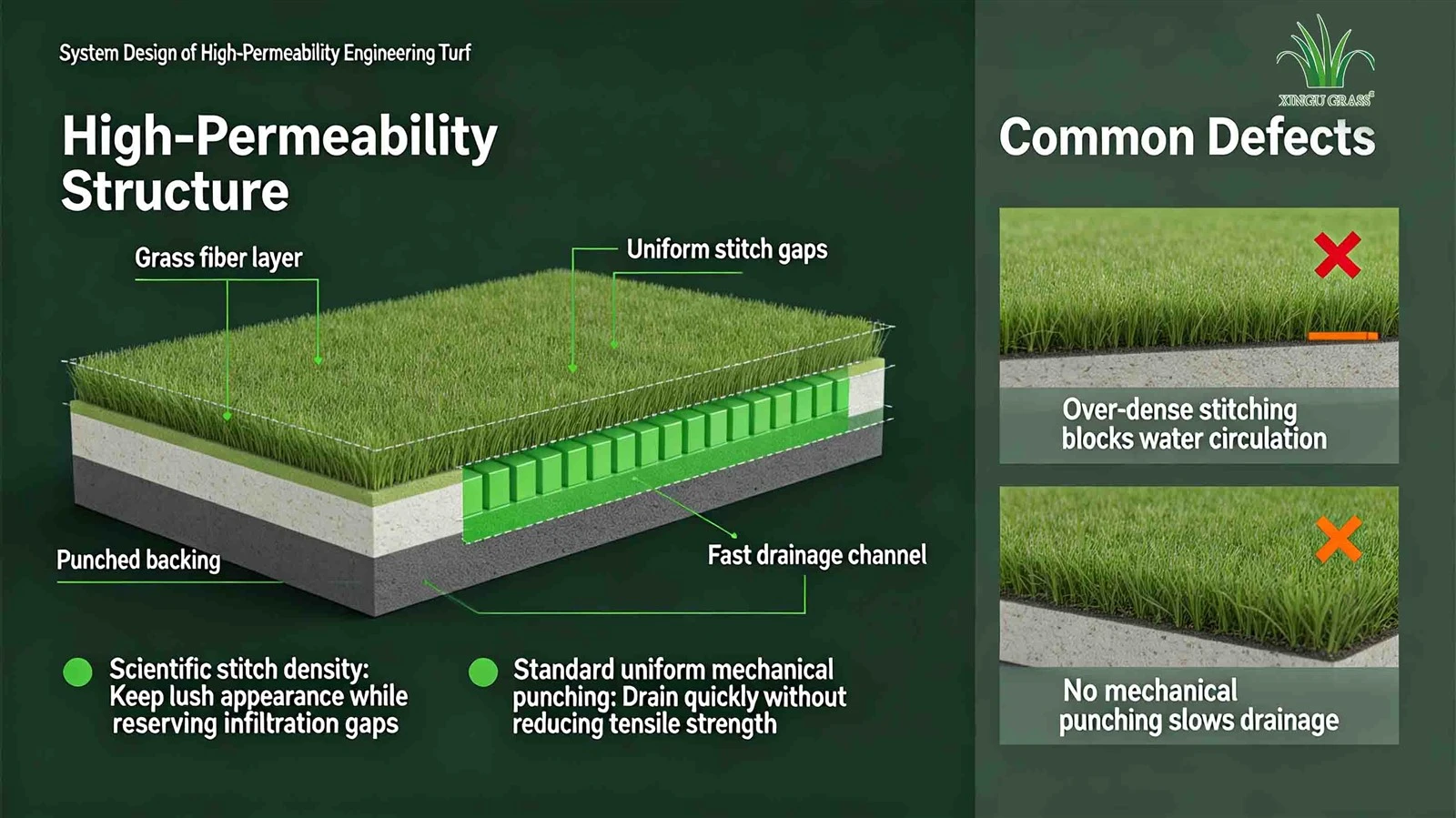
The excellent water permeability of premium engineering-grade artificial grass relies on a systematic structural design, rather than simple backing punching. Firstly, professional weaving technology adopts a scientific stitch density layout. It maintains a full, natural appearance and comfortable foot feel while reserving uniform gaps for even water infiltration and avoiding local ponding. Secondly, the turf backing is processed with standardized mechanical punching with uniform hole distribution. This sophisticated process never weakens the tensile strength of the backing while achieving ultra-fast water penetration and instant drainage.
Low-cost inferior turf generally has two fatal drainage defects. Some manufacturers excessively increase stitch density to create a fuller visual effect. The over-tight grass layer blocks air and water circulation, resulting in stagnant surface water after rain. Other cheap products skip the mechanical punching process to cut costs, relying only on natural fabric gaps for drainage. The extremely slow drainage leads to long-term slippery surfaces, posing major safety hazards and failing to meet the standards of municipal and sports engineering projects.
Different application scenarios require different levels of water permeability. Basic decorative turf for courtyards and balconies only needs standard drainage performance. In contrast, turf for park walkways, commercial plazas, rooftop greening, kindergartens, and sports fields demands superior drainage capacity. Specifically, ponding on rooftop turf increases building load and causes roof leakage and corrosion. Water accumulation on sports fields leads to slippery surfaces and fall risks, disrupting normal use. Qualified engineering turf delivers excellent water permeability, ensuring no standing water even after heavy rain and immediate site availability after rainfall.
Water permeability also greatly influences the aging resistance and overall durability of artificial grass. Efficient drainage keeps the turf backing dry at all times, preventing mildew, pulverization, and delamination caused by prolonged dampness of latex or PU adhesive. A dry bottom layer effectively inhibits moss and mold growth, keeping the turf clean and greatly reducing later maintenance costs. This explains why high-quality engineering turf requires minimal upkeep, while inferior products easily turn black, smelly, and dirty.
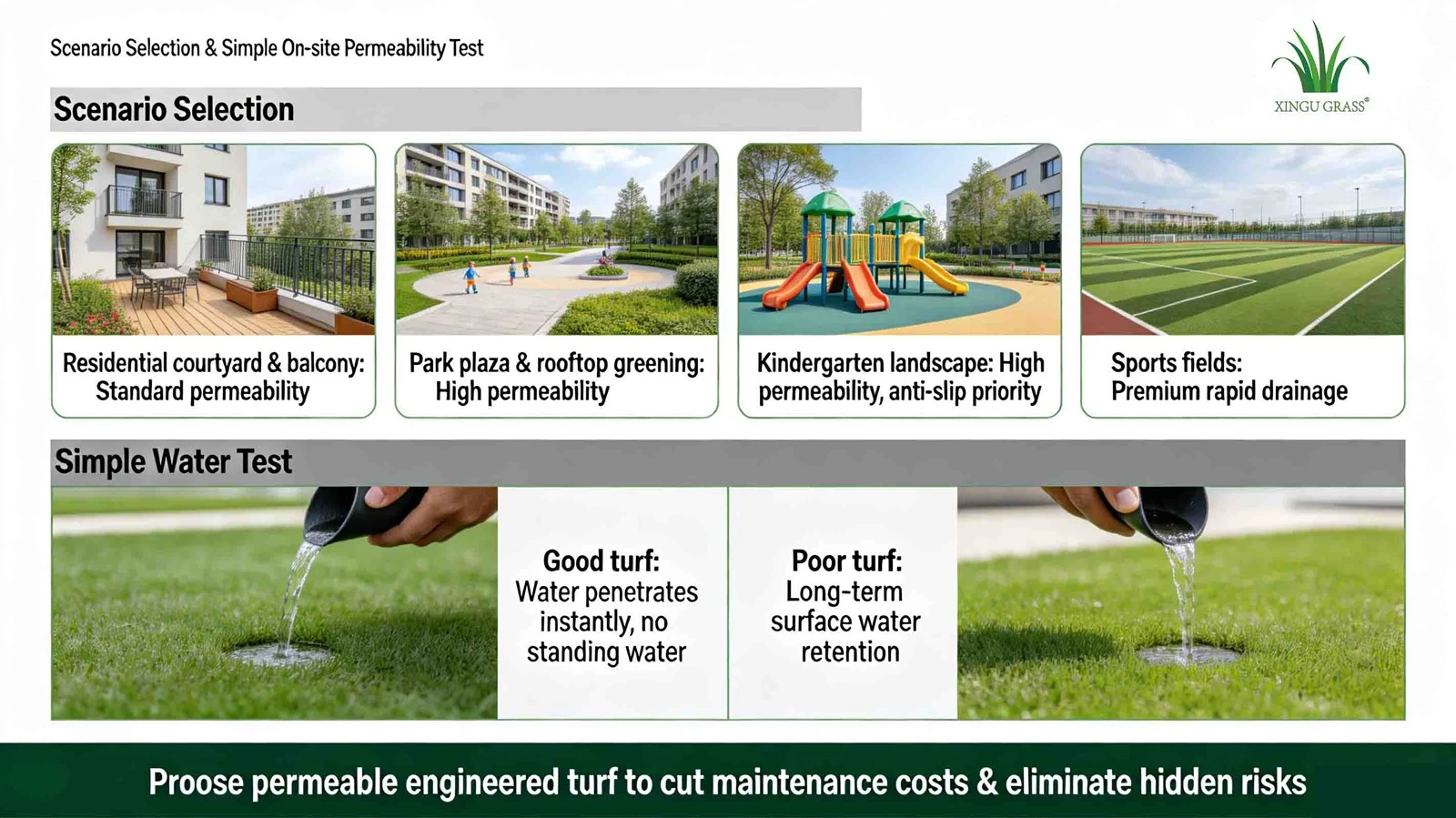
For international traders and engineering clients, testing turf water permeability is simple and requires no professional equipment. Pour clean water evenly on the turf surface. Premium-grade turf allows instant water penetration with no residual ponding. In contrast, low-quality turf retains obvious water layers for a long time. Buyers can comprehensively evaluate product quality by checking backing punching craftsmanship, stitch spacing, and breathable adhesive structure to avoid inferior products with falsely labeled parameters.
In conclusion, water permeability is a core functional performance of artificial grass and a vital guarantee for the safety, stability, and durability of outdoor projects. Conventional appearance parameters determine the turf's aesthetics, while drainage performance defines its long-term service quality. When selecting turf for projects, abandoning one-sided focus on appearance and prioritizing professional permeable structural design helps developers and contractors obtain low-maintenance, long-lasting engineering-grade turf, eliminate hidden project risks, and improve overall project quality.