

Analysis Of UV Resistance Performance Of Artificial Turf
Jul 06, 2026
Among the core performances of artificial turf, UV resistance is a key indicator that determines the service life and overall effect of outdoor turf, and it is also an easily overlooked factor in outdoor projects and overseas site procurement. Most buyers focus on intuitive parameters such as yarn height, density and price, while ignoring that UV aging caused by long-term outdoor sunlight exposure is the core cause of turf fading, embrittlement, yarn shedding and glue falling off. Especially in tropical and subtropical regions with high temperature and strong sunlight, ordinary artificial turf without UV-resistant technology is prone to rapid aging and failure. Through raw material modification, additive enhancement and weather-resistant process optimization, high-quality artificial turf possesses excellent UV resistance, as well as high temperature resistance, cold resistance and flame retardancy. It can adapt to various complex outdoor climatic environments, greatly extend the service life of the site and reduce subsequent maintenance costs, serving as the core guarantee for the quality of outdoor artificial turf.

The essence of UV aging is the destruction of the polymer structure of artificial turf yarn, which is the main cause of outdoor turf failure. Artificial turf yarn is mainly made of polyethylene polymer material. Long-term intense UV radiation will continuously decompose the molecular chains of the material and trigger oxidative aging reactions, causing irreversible damage to the turf. Most low-cost ordinary turf on the market adopts recycled raw materials without special UV-resistant additives. Under strong sunlight exposure, it will experience overall yellowing and whitening, brittle and broken yarns, and large-area yarn shedding within two to three years, seriously affecting the appearance and usability of the site. In contrast, high-quality football turf is blended with professional UV stabilizers, antioxidants and other functional additives during the production process, allowing protective ingredients to penetrate the entire yarn and fundamentally resist UV oxidative damage. Equipped with high-quality polyurethane backing glue and thickened weather-resistant base fabric, and certified by professional xenon lamp aging tests, it maintains uniform color and flexible wear resistance after long-term sun exposure, perfectly adapting to high-temperature and strong-sunlight outdoor scenarios and extreme tropical climates overseas.
High-quality UV-resistant artificial turf has all-round weather resistance advantages, with far better adaptability and cost performance than ordinary turf. Resistant to strong sunlight exposure, it features excellent high temperature resistance, maintaining stable performance without softening, deformation or fading under high surface temperatures in summer. It also has outstanding low temperature resistance, preventing yarn stiffness, embrittlement and shedding under temperature differences and low-temperature weather, ensuring stable all-weather use. In addition, the turf has inherent flame retardant properties that meet outdoor site safety standards and effectively avoid potential safety hazards caused by open flames. It is widely applicable to football fields, campus venues, outdoor leisure sites and other scenarios. Although the initial procurement cost of high-quality UV-resistant turf is slightly higher, it can serve for 8 to 12 years without frequent maintenance, renovation or replacement. It has lower long-term use cost, higher stability and safety, making it the preferred choice for outdoor artificial turf projects.
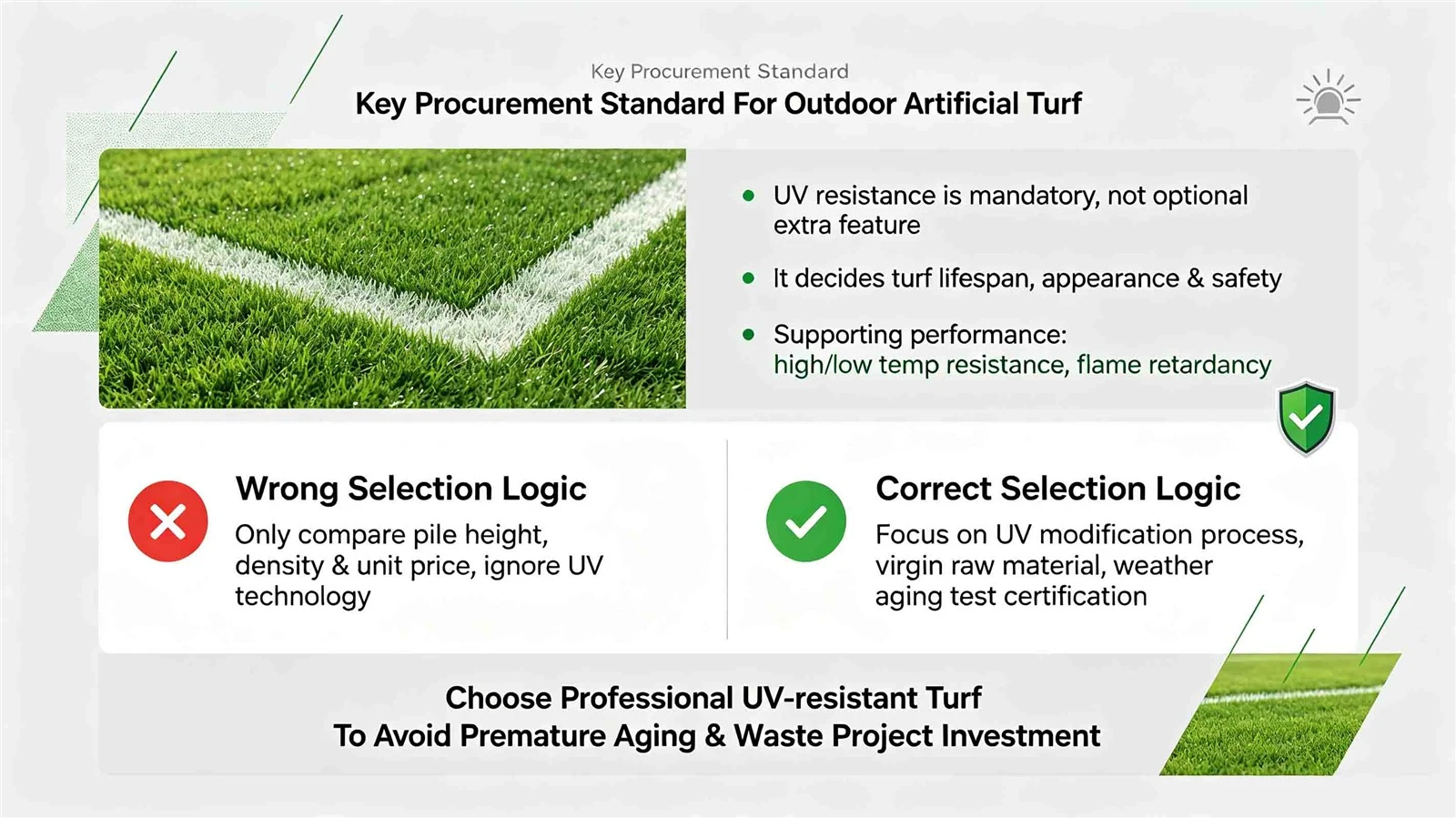
In conclusion, UV resistance is an essential core performance requirement for outdoor artificial turf rather than an optional additional feature. It directly determines the service life, appearance and safety of artificial turf, and advantages such as high and low temperature resistance and flame retardancy are supporting core performances of high-quality weather-resistant turf. In the selection and procurement of artificial turf for engineering projects, evaluation should not be simply based on price and appearance parameters. More attention should be paid to UV-resistant technology, raw material quality and weather resistance testing standards. Only by selecting high-end artificial turf with professional UV modification and qualified quality can we effectively cope with various complex outdoor climates, avoid premature aging and scrapping problems, ensure long-term stable use of the site, and achieve double guarantees of project quality and economic benefits.


