


What Test Reports Should Contractors Request Before Large-Volume Artificial Grass Shipment
Aug 27, 2026
In global artificial grass engineering procurement, most project disputes, return risks, and post-installation failures do not stem from on-site construction errors, but from unqualified batch quality and missing compliance documents before shipment. For contractors, landscape companies, and bulk turf importers, verifying complete standardized test reports prior to large-volume shipment has become a core risk-control step to stabilize project quality, pass tender acceptance, and avoid massive economic losses.

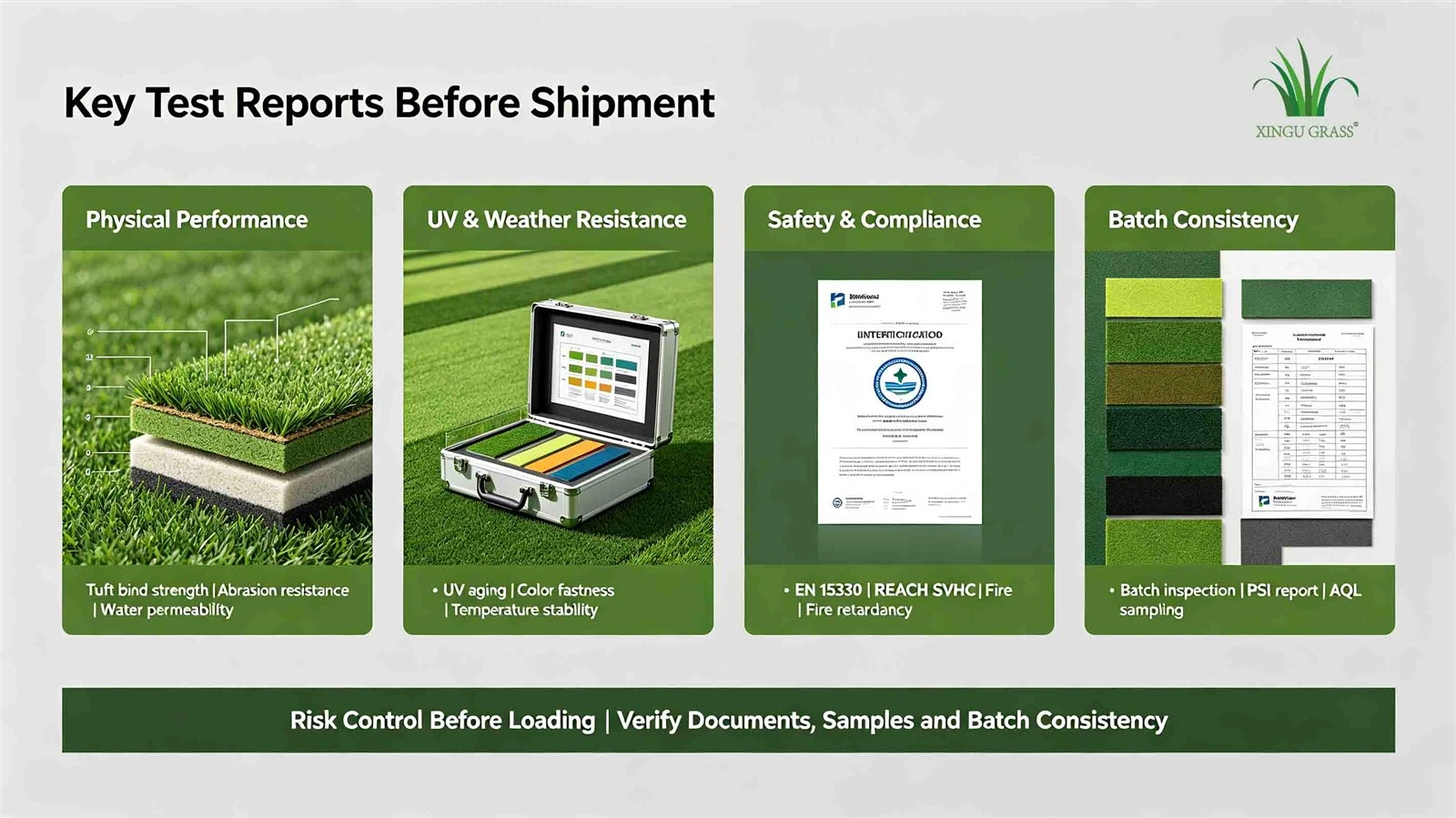
Many suppliers only provide basic parameter sheets for quotation, while hiding batch inconsistency, insufficient anti-aging performance, and substandard safety indicators. Once untested bulk turf is shipped overseas, problems including uneven color fading, fiber shedding, backing delamination, and unqualified environmental safety will lead to project rejection, customer complaints, and high rework costs. Therefore, professional contractors must strictly screen four categories of authoritative test reports before shipment to ensure full compliance with international standards and local project specifications.
First, core physical performance test reports are the basic guarantee of turf durability, covering all key indicators related to service life and on-site usability. This report set includes pile height uniformity, stitch density, tuft bind strength, abrasion resistance, and water permeability. Different from nominal paper parameters, third-party verified physical data can effectively identify inferior products with thin yarn, insufficient weaving density, and weak glue adhesion. For high-frequency sports venues and large landscape projects, stable tuft bind strength and abrasion resistance data can completely avoid fiber shedding and layer separation failures in long-term outdoor use.
Second, anti-aging and weather resistance test reports determine the long-term stability of outdoor turf projects, especially critical for high-temperature, strong ultraviolet, and high-latitude cold regions. Contractors must request formal UV resistance accelerated aging test data and color fastness test reports with clear Gray Scale ratings. Regular qualified turf requires stable performance after thousands of hours of UV irradiation, without obvious fading, brittling, or cracking. This set of data directly proves whether the product adopts qualified UV stabilizers and anti-aging additives, eliminating premature aging risks of low-cost turf within 1–3 years of installation.
Third, international safety and environmental compliance reports are mandatory pass standards for global market access and project acceptance. Core certifications and test reports include EN 15330 sports turf standard test, ISO 9239-1 fire retardancy test, and REACH SVHC environmental detection, which strictly limit harmful substances such as heavy metals and phthalates. For school playgrounds, community public venues, and indoor landscape projects, non-toxic, odorless, and environmentally compliant test reports are indispensable tender and acceptance documents, effectively meeting EU and global market safety access requirements.
Fourth, batch consistency and pre-shipment inspection reports are key to avoiding large-area project defects caused by batch differences. Mass production inevitably has raw material and process fluctuations; formal suppliers need to provide batch color difference detection, finished product sampling test records, and professional pre-shipment inspection (PSI) reports. Standardized sampling rules and AQL quality inspection levels ensure consistent color, specification, and performance of each batch of goods, preventing patchy lawns and unqualified overall projects caused by batch discrepancies.
Industry experts emphasize that FIFA certification, CE certification, and ISO qualification certificates only represent the supplier's overall production capacity. For each large-volume order, contractors must insist on batch-specific targeted test reports instead of universal expired certificates. Matching test data with actual order specifications is the core of professional procurement risk control.
Conclusion
Complete test reports are the most intuitive quality guarantee for large-volume artificial grass shipments. By verifying physical performance, weather resistance, environmental safety, and batch inspection documents before delivery, contractors can completely eliminate hidden quality dangers, ensure stable project delivery, reduce after-sales maintenance costs, and build long-term stable cooperative relationships with end customers in the competitive global turf engineering market.


